
Oxygen matters at bottling.
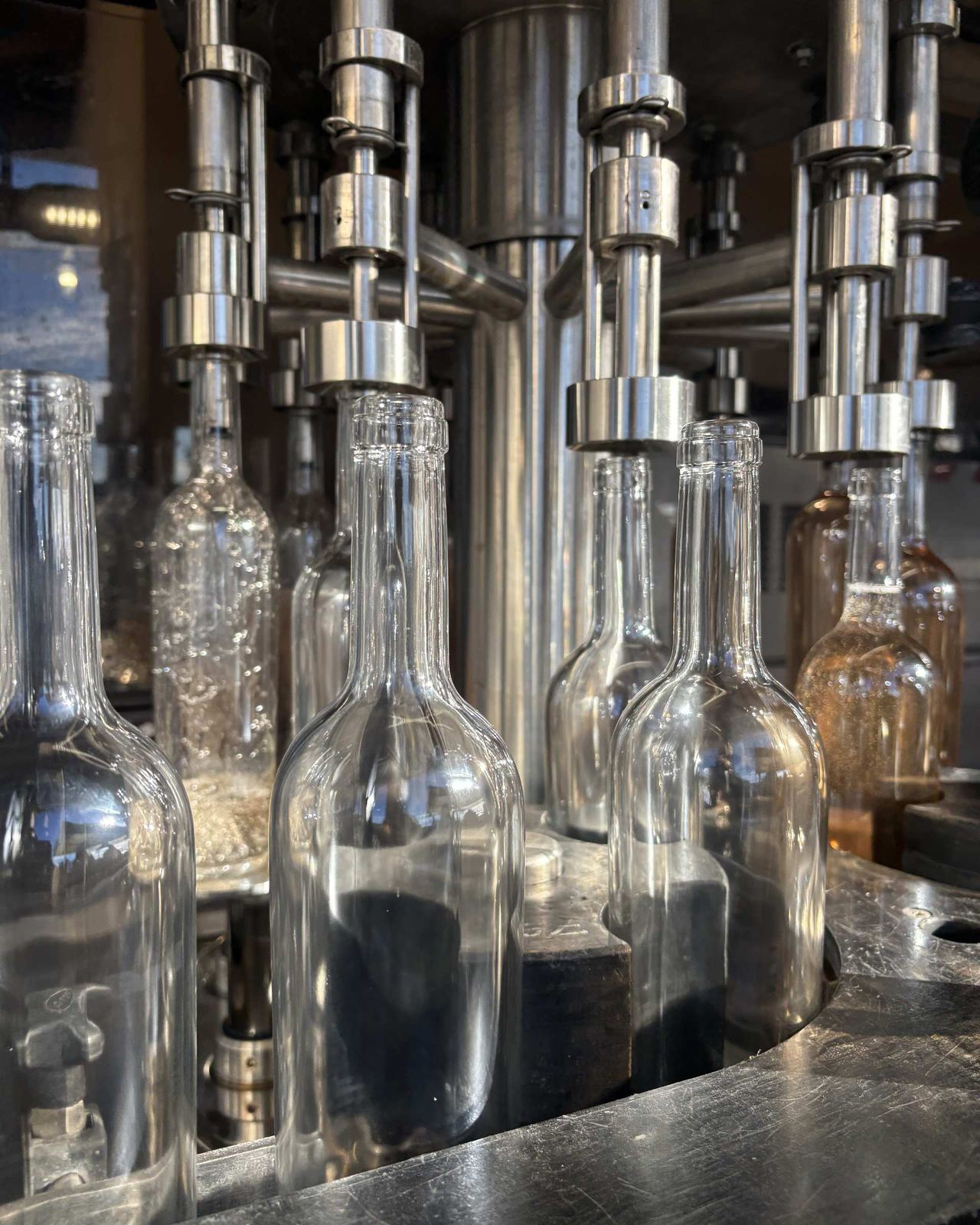
Women and men oversee the wine’s passage into bottles. Their attention also extends to what cannot be seen: oxygen and its consequences for the wine’s protection.
Women and men work around the bottling line. They follow the bottles as they move, watch the equipment and pay attention to bottling conditions. The movement is visible; the exchanges between wine and oxygen are not. Yet this is also where the work calls for precision: filling a bottle is not enough to preserve what it contains.
The wine arrives with characteristics developed through the work carried out before bottling. Bottling is not intended to create or improve them. Its purpose is to help retain them. At this stage, wine can be preserved or harmed, depending in part on its exposure to oxygen. The task is therefore to protect an existing balance, without seeking to redefine it.
A small amount, a measurable consequence
One milligram of oxygen per litre can cause wine to lose up to four milligrams of its free SO₂. Free SO₂, meaning the unbound fraction of the sulphur dioxide present in wine, contributes to its protection against oxidation, among other functions. A decrease in this fraction therefore reduces part of the protection available.
The words “can” and “up to” matter. The stated fact does not predict a systematic, identical loss for every wine. It describes a possible consequence, with a stated upper limit. Nor does it allow you, on its own, to predict how a bottle will taste or how long it will keep. It does, however, provide a concrete reason to take oxygen seriously during bottling.
Preserving rather than correcting
Oxidation, in other words the chemical changes to which oxygen contributes, can alter a wine’s aromas, colour and taste. This does not mean that every contact with oxygen immediately produces a perceptible fault. It means that, during bottling, exposure needs to be considered in terms of its possible consequences, not just what can be observed at that moment.
If you watch a line in operation, you mainly see containers moving and filling. You cannot infer from this how much oxygen the wine has received, or any resulting loss of free SO₂. The appearance of the bottles and the smoothness of their movement are not enough to judge how well their contents are being preserved. Care at bottling also concerns this invisible dimension.
Keeping what the wine already has
The responsibility of bottling thus has a clear boundary: packaging must not be confused with winemaking. Wine does not wait until this stage to acquire its identity. The work consists of respecting its organoleptic properties, meaning the characteristics you perceive through your senses, rather than giving it new ones.
This is the role of Épure, a bottling centre in Brignoles, in Provence Verte. Épure does not make the wine: it works to ensure that the wine retains all its organoleptic properties. Attention to oxygen serves this purpose of preservation. It continues the care already given to the wine, without taking its place.
Written with the help of artificial intelligence, and reviewed before publication.